
Monthly Archives: April 2010
USSR WAR IN AFGHANISTAN 1979 – 1988 Part 2
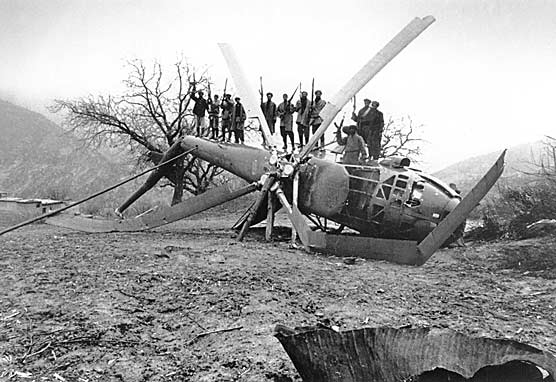
1980 100,000 USSR Soldiers: Soviet soldiers were promised combat against American troops by the KGB but this claim was an obvious lie. The Soviet war was useless because the Mujahadeen consistently reappeared after the previous days of fighting. Mujahadeen had internal conflicts. Gratitude lasted seldom longer than a few hours. The War was fought with Mujahadeen blood and with America’s goal: to end communism in Russia. The USSR abandoned massive sweeps with air based tactics. The UN pushed for shuttle diplomacy saying that if Russia left Afghanistan the US would stop supporting the Mujahadeen. (Similar to Iran’s promise with Americans). The USSR bombed Aghanistan from the air. The Soviets destroyed a whole village. Many young men were forced into the Afghan army those who refused were shot. The toll of Soviet dead was as much as 2000 per year. The soviet arm was largely drunk, drugged, and felt the war was pointless.
As a soldier in the USSR, you realized that the system creates lies in USSR. The USSR lied to its public claiming that there was no war but that their soldiers were building schools. The USSR would not allow people to write on their son’s gravestone regarding where that son had died: Afghanistan. Gorbachev had to explain what the point of the war was: they needed to find a process for escape. It was difficult to withdraw from Afghanistan. What kind of government would emerge without the USSR in Afhgnistan. USSR choose a new leader in Afghanistan: Nagibula. They needed a peace initiative with the Mujahadeen. The USSR needed US support. But Reagan wanted to make the USSR pay for Vietnam. The Mujahadeen were given USSR weapons by increasing US aid. The USSR was punished brutally in this war. 
USSR WAR IN AFGHANISTAN 1979 – 1988 Part 1
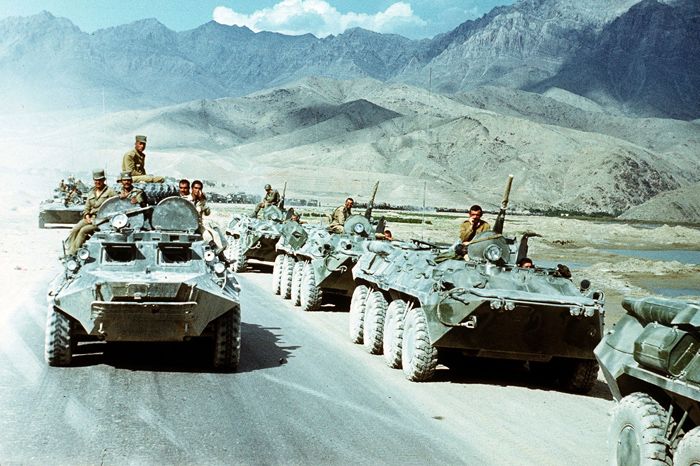
It was the Vietnam syndrome for the USSR as a superpower: impossible to run away from that country. Afghanistan is a traditionally an Islamic nation. Afghanistan has a history of conquest. It became a focal-point for Cold War conflict. Afghanistan was strategically important for oil. US aided Islamic fundamentalist.
AFGHAN CRISIS:
In 1978 a communist government emerges. The Afghan government of Taraki looked to the Soviet Union for support. Moscow sent hundred of advisors, military trainers, and military supplies to Afghanistan in 1978 – 1979. Afghanistan was an agricultural country and the government advocated land reform allowing peasants to achieve egalitarian objectives. Women were encouraged to stop wearing veils and began schooling. The rural communities opposed these changes and the Mullahs felt that the communists were trying to destroy Islamic tradition. God must decide who is rich or poor according to the Mullahs. Mullahs attempted to burn schools. The Kabul Taraki (http://en.wikipedia.org/wiki/Nur_Muhammad_Taraki) government was trying to build socialism for 5 years, the regime was vastly ignorant. There was a holy war declared against the godless communist government of Afghanistan. Russia might move south to seize oil in Iran as was feared by Jimmy Carter. The Shahs fall in Iran meant the US had few allies in the region. The US gave covert aid in July 1979 to the Mujahadeen.
The invasion by the USSR into Afghanistan was an affront against US foreign policy interests. The Afghanistan government was replaced by Amin however, he realized that the USSR wanted him out. The Russians were concerned that Amin would ask for US assistance and support US invasion. Russian sent troops in after Americans had deployed cruise missiles to threaten the USSR’s military superiority in the region. The Politburo in the USSR a) feared Islamic fundamentalism in Afghanistan, b) if the USSR did not enter Afghanistan some one else would, c) there was instability between the USSR/Afghanistan border. KGB special-forces killed Amin in his palace.
Karmal was the president of Afghanistan. The Soviet invasion of Afghanistan was seen as a threat to world order because it was the first invasion outside of the Warsaw Pact. Jimmy Carter issued a threat that if the USSR invaded Pakistan or Iran he would respond with Nuclear War. The soviet invasion was widely condemned at the UN. The 1980 Moscow Olympics were boycotted. The US supported the Mujahadeen in a clandestine manner: God was on their side. The idea was to allow for the bleeding of the USSR in Afghanistan. US bought Soviet arms from Czechloslovakia (corrupt), Egypt, and China. Pakistan wanted a strongly Islamic neighbour even with nuclear weapons interests and drugs as long as the Afghan resistance was supported.

UNDERLYING CAUSES of Partition
Underlying causes of the Partition of Pakistan & India:
a) British departure: The cost of India was too high for Britain. The removal of a colonial power which frequently served to consolidate interethnic tensions led to the resurgence of such conflict between the colonized communities.
b) Conflict between communities had persisted for centuries (possibly longer) but the competing political movements opened the flood-gates. During uncertain times human beings tends to rally around what is most psychological comforting. For example, their relatives, their religious denominations, their perceived Nation. These groups tend to turn to their signposts and pit themselves against the Other which threatens their resources, community, and lives: (See Henry E. Hale, The Foundations of Ethnic Politics: Separatism of states and nations in Eurasia and the World)
c) Institutional Advantage for Nation-State Creation: The preexisting institutional structure of India provided the transitional infrastructure for an independent India. The somewhat federated structured of Indian dynasties allowed for the transition to quickly produce a clear delineation between Muslim and Sihk and Hindi Indians. (Phillip G. Roeder, Where Nation-States come from: Institutional Changes in the age of nationalism).
d) Mobilization by politicians through the available divisions in society. Politicians divide for their own sake: power through using the signposts available to them. In regions where there is no clear majority, mobilization along ethnic lines is not tenable. Where there is a majority, lack of economic opportunity, and insecurity, politically motivtedviolence is produced. Such violence may be culturally enforced as well. In the Muslim league, there was a fear of zamindar system (http://en.wikipedia.org/wiki/Zamindari) being abolished which would weaken the power of the zamindar families, for example. Partition was justified because it was better to abandon a united Indian in order to avoid policy standardization from a socialist central government in New Delhi. 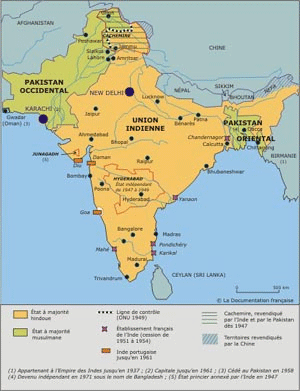
Nehru supported a united India but accepted partition because there was inequality between Muslim and Hindu peoples. Jinnah of the Muslim League was completely unwilling to move on the issue of India’s partition. His support for a new Muslim state as Pakistan was based on the issue of democratic representation of a Muslim minority. One year after the partition he died. Had he died earlier partition may have been avoided but this is speculative and another political leader might well have advanced Jinnah’s goals in his place. The Partition is another dubious sign of cultural groups with deeply divergent philosophies of being able to co-exist under a unified state.