
Category Archives: Business
Walt Disney: Don’t Be A Middle Man / Own Your Creative Output
 Walt Disney’s early entrepreneurial experience took him to Kansas City to start a company called Laugh-O-Gram. The two Disney brothers learned early that owning the character and controlling intellectual property was essential. In 1926, the Alice Adventure cartoons (mixed live and animation) were put to rest as they weren’t gaining traction so Iwerks and Disney created a new character called Oswald The Lucky Rabbit.
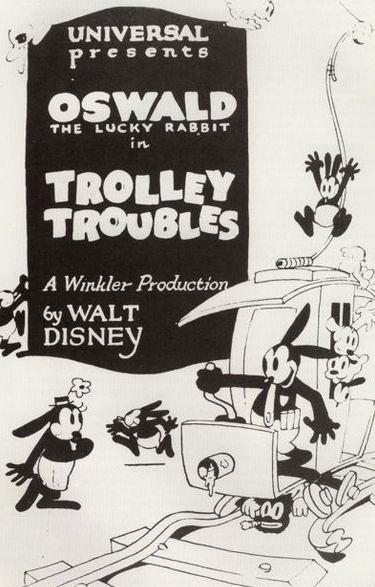
With the help of Iwerks, Disney began to see great success with Oswald The Lucky Rabbit, which was created under licensing through Winkler Pictures. Unfortunately, the copyright contract was up for renewal within a year and so Walt Disney headed to New York in order to renew ownership of Oswald but Charles Mintz who worked at Winkler Pictures had already stolen the Oswald The Lucky Rabbit character from Walt Disney. Mintz started his own cartoon production with most of Disney’s staff. Mintz figured he could do the cartoons just as well as the Disney studio for cheaper and also cut out the middle-men. In those days, the distributor owned the rights to the character and they outsourced the creative to studios such as Laugh-O-Gram. Mintz ended up doing a favour for Disney since Iwerks immediately developed another character called Mortimer Mouse later Mickey Mouse.
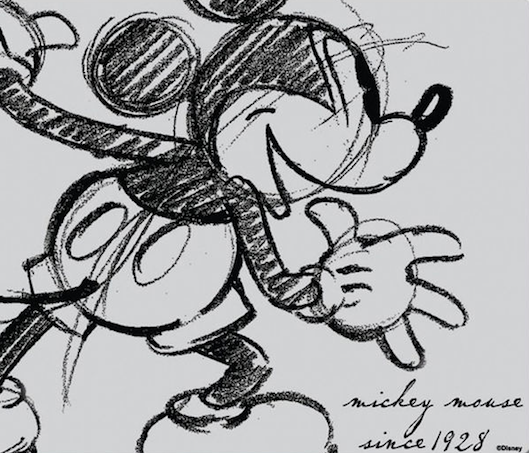
So after this lesson in licensing, Disney would go forward ensuring that he owned the distribution rights. Disney later on would actually re-release films like Snow White and Pinocchio regularly every 7 years after their original release since these films could be deemed timeless and Disney could control access. Disney engaged in mass merchandise sales using his film characters to build idolized characters. Only after the release of Little Mermaid was home viewing of Disney content expanded significantly. Controlling who can view and how they viewed Disney content was essential for generating reliable revenue streams for Disney as demonstrated from his early experience with intellectual property.
Mark Carney’s Perspective On Britain’s Economy 2014
Jeremy Paxman (aka Paxo) grills the Edmontonian in this BBC Newsnight interview but Carney is un-phased for the whole affair. The big question is “what is going to happen to productivity in the UK”. There has been an increase in employment but value generation in Britain is yet to truly be realised. In sum, Britain is doing well. a) Inflation is back on target, b) there are 300,000 new private sector jobs and c) the UK is the strongest growing economy amongst advanced countries. Carney is trying to hold back banker bonuses which Ed Miliband opposes in some way(?); definitely well played answer there. Mark Carney finds Bitcoin interesting; the free banking in Canada and the US in the 19th century in which banks could issue their own notes inevitably led to a value spirals. Bitcoin doesn’t work in that fashion but for Carney, BitCoin is just interesting. What works better is an independent institution like the Bank of England regulating the system, with civil servants focused on optimising the economic performance as much as any centralised institution can.
The Dark Side of Digital Labour
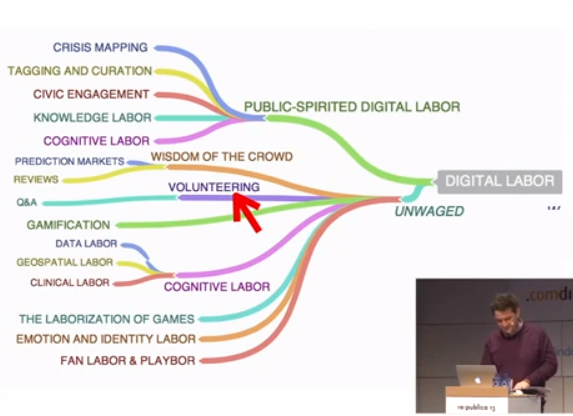
Summary of Trebor Scholtz’ Talk The talk is an overview of online crowdsourcing which is wiping away 100 years of progress in labour rights according to Trebor Scholz.
 Digital labour is now allowing for a return to child labour, 8 hour work day, unethical business practices ALL through distance based employment. There is an increased precarious lifestyle emerging with unpaid student internships are being one characterisations offline as well as sweat shops in the Philippines. What we are seeing now is a new digital workforce that is being exploited by entrepreneurs.
 Business has used interesting language to characterise these activities. These labourers don’t see themselves as employees. They call themselves task-rabbits, cloud-workers. Amazon’s Mechanical Turk has anonymous tasks that pay very poorly. Mechanical Turk is 70% US female workers and 30% India degree educated workers. Research shows that some people aren’t doing these tasks for money, they trying to learn English. 18% of Amazon Mechanical Turk users are considered full time: $2.00 per hours. There are problems like delayed payment, mobilisation for labour rights is not easy. Users pick from a wide range of task Clickworkers are working as if it is past time. Playbour is another way to describe this labour. From Scholz’ perspective, their activities are considered totally alienating: no identity of the employers and the works on Amazon’s Mechanical Turk (you don’t get to see who your employers is for example).
 Other forms of so-called Playbour are less obvious. HuffingtonPost started in 2005 by aggregating various leftwing blogs with posts from Obama and Oprah alongside random quality bloggers until 2011 when Mrs. Huffington sold the company to AOL for $350 million dollars. The bloggers were not compensated for the new wealth acquired through this transaction. In fact, the bloggers were never ever paid for any of the posts that were featured on the site. A strike was endorsed by the Newspaper Guild of America and even a lawsuit of $105 million was filed for compensated. That class action lawsuit was lost and the strike ended rather quickly. Making money off the backs of bloggers was exactly how Huffington made her wealth from Scholtz’ perspective. This is another example of people writing for exposure when they don’t even know the value of their work.
 “If you are not paying for a service the chances are you are the product, according to Trebor.” Dallas Walker Smythe (from Saskatchewan, Canada) coined the idea of the audience commodity. Facebook, Linked etc are all engaged in cognitive labour. Every time we make a Facebook post or send Linkedin message, we increase the value of those companies through the page views that this newest form of exploitation generated. Depending on how valuable the other half of the exchange is to you as user. Alternative structures to facebook.com have had technical problems of their own. They didn’t manage to bring in users. Example, Diaspora.com which could have been (may still be) the alternative….
 Positive Models for Crowdsourcing: There are some positive non-commercial forms of work that Scholtz really likes. Such as Distributed Proofreaders, ScienceCommons, Click Workers which is public spirited. Scholtz wants to restrict other kinds of work. Fairnopoly is an example of a fair-trade marketplace that is worth looking into further. There are new efforts to unionise online labour. Unionised labour online for crowdsource. Crowdspring has had a law suit from a user who feels he was a user. With Amazon Mechanical Turk now allows for a tool called Turkopticon to have more accountable employee and employer relations. Trebor Scholz is looking to help users sue major companies like Amazon and then states that these lawsuits will likely fail base don the laws on the books but perhaps one crazy judge will make a descending decision….
 Motivation in crowdsourcing is another paradoxical discovery. Paying people to make Wikipedia entries actually has an interesting result; having multiple prices for your contribution based on posts actually demotivates them. Trebor Scholz labour standards should be brought online: he thinks it is absurd to underpay people online & Scholz is very angry about that.