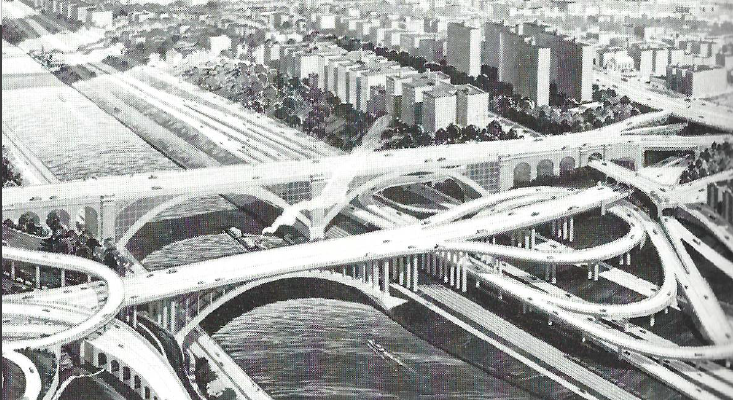
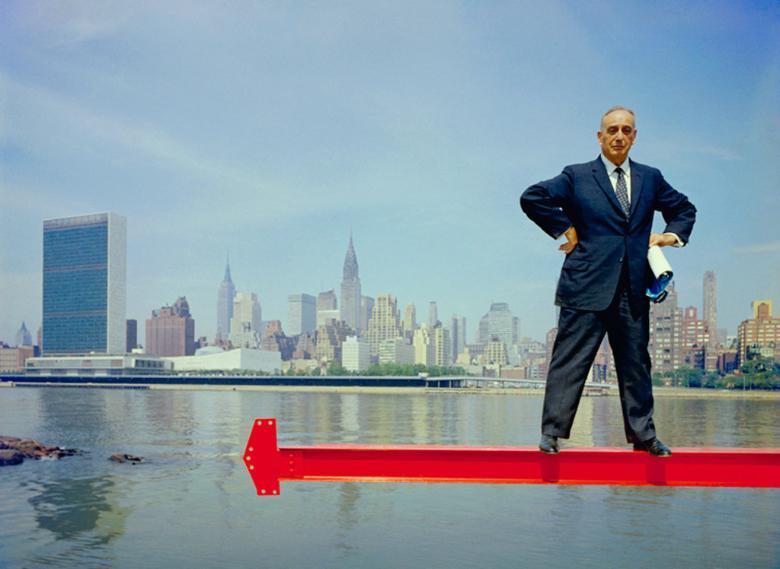
The history of road building and urban development through the ages has been one of immense constructions through relatively unpopulated areas, such as the Silk Road bringing goods from the Far East to Europe. But the developments carried out by Moses could only be compared to the reconstruction of Paris carried out by Baron Haussman, in that they were constructed in a heavily populated urban environment. This involved not only a substantial engineering effort, but the management of multiple disruptions in a busy city. In order to construct the new highways which criss-crossed the city, Moses’s engineers had to hack their way through whole communities. In terms of size, Moses’s development was comparable to anything in history. In terms of complexity, it would dwarf them all.
As impressive as the engineering feats were, Moses’s ability to raise the funds for these developments were equally impressive. To Moses, wars were mere inconveniences. Even during the height of the Second World War, Moses was still able to obtain the necessary funds and materials.
Moses manipulated the city like a player moving buildings around on a Monopoly board. He was never happier than when he was developing plans that would totally transform communities as if they were blocks on a child’s game. This also involved complex political manoeuvring. It took the mind of a dictator to carry out these plans, when the persuasion of a specific mind is sufficient. In a democracy, the scale of the public works carried out by Moses was unprecedented. This was carried out, in effect, by ignoring democracy. Moses just laughed at the protests against the highways he built. He said, “You can indulge your every whim on a clean slate…but when you operate in an overbuilt metropolis, you have to hack your way with a meat axe.”
Analysis & Key Takeaways
He loves the public but hated the people, especially the poor anyone who intervened in his vision was a threat, in a democracy, there would always be a significant group willing to block progress in exchange for rents;
A Man For All Seasons; “I would rip down all the laws to get at the devil, but the problem is what if the devil were to turn on you what tools would be left to defend yourself with?”
Robert Moses built six hundred and twenty-seven miles of roads in and around New York City. This is the story of one mile. It was part of the Cross Bronx Expressway and unlike most of Moses’s roads which carved straight lines through the city, it swerves and bulges. The key to why is in the apartment houses that are located in the route. By going straight on, the road would only have demolished a handful of apartments. By taking the route it eventually did, it destroyed a whole neighbourhood.
This was a poor area called East Tremont with a large, integrated immigrant community. There were few open spaces but there was a large popular park nearby, as well as the Bronx Zoo. There were bustling streets of shops full of small businesses. Many people worked in the garment industry. There were good schools with high standards. The apartments were old but roomy and the rent was low. There was a sense of community; of belonging.
Black and Hispanic residents started to appear after the war and by 1952 they represented ten per cent of the neighbourhood. They were also integrated with few problems. People with decent housing and low rents are more likely to adapt than move out.
In December 1952, letters started to arrive at the apartments, signed by Robert Moses, telling the residents that their home was to be demolished to make way for a new highway and giving them ninety days to vacate. The result was panic. When the residents found out about rent rates in other parts of the city, local committees began to form. They visited other sites where the highway had driven through apartments and saw the chaos it left behind. The city housing department had done little in terms of relocation. This was to be the future of East Tremont.
There was still hope in the form of the mystique of Robert Moses. The committee was sure that they could persuade Moses to change the route. They hired one of Moses’s engineers to plan a new route. By running the expressway through the nearby park, many of the apartments would be saved. But neither Moses or any of his aides would consider a change.
The committee formed into the East Tremont Neighbours Association (ETNA) and appointed a local housewife, Lillian Edelstein, as their head. They tried their arguments with other members of the city authority. They received support from their congressman and city officials. The borough president approved of the new plan, but Moses angrily threatened to remove funds and resign. At the first board hearing, Moses’s plans were denied, partly due to pressure exerted by one hundred East Tremont housewives including Lillian Edelstein. However, in the following board meeting Moses got his way and his destructive plans were waved through. Edelstein needed ten thousand dollars to mount a legal challenge and she worked tirelessly to raise it. Engineers worked on detailed plans for an alternative route which were sent to the press, but the press were of little help.
However, elections were due and the Association directly challenged the politicians. They had positive reactions from Mayor Wagner, who promised to vote for ETNA’s plan. After an intervention from Moses however, where he again threatened to withdraw funds, Wagner broke his promise. At the final board meeting, Moses assembled a group of his own engineers. The tenants had their own engineers and a reporter, who was ejected. ETNA walked out and in their absence Moses’s plans were approved.
So why didn’t Moses change the route? One story is that one of Moses’s connections had property in the area and the curve on the route was in order to avoid it. It could have been merely of whim. More likely, it was to avoid pulling down a bus terminal in which local politicians had an interest. Whatever the reason, once Moses had made a decision, any attempt to overturn it would be seen by Moses as a personal affront.
The final struggle for the residents was relocation. Despite promises from the Mayor, there was little or no provision for relocation and at best, residents were offered properties that were much smaller, much dirtier and much more expensive. Utilities were switched off at the condemned tenements. In mid-1953, the residents were sent letters giving them a month’s notice. By June, have the residents had left. Workers began tearing down the tenements while the remaining people were still living there. Vandals moved in and stripped the vacant properties. Fear would be the greatest relocator of all.
Analysis & Key Takeaways
Eminent domain is a contractual weapon Robert Moses used to exact his vision….
Wagner had a change of heart and the project goes forward as the community goes up against Moses contra the Cross-Bronx Expressway and there was no reason to go through the East Treamont, Robert Moses didn’t care about the small people; Moses’ slum clearance committee didn’t help him out;
Robert Moses believes that if you build a park then you are on the side of angels. So of course the parks are the organic part of the project and the inorganic side was the infrastructure revenue generating tactic.
The Cross-Bronx Expressway was not to complete development until 1960, five years after the residents had been evicted. To keep the Expressway level, the engineers had to blast through solid rock. Tenements nearby began to crumble. The noise was deafening from the constant drilling and the dirt and dust got everywhere. There were ten thousand people living near the development. They began to move out. New impoverished people, many of them poor blacks, moved in.
After completion, the Expressway caused new problems. The rise of carbon-monoxide from the six-lane expressway below was visible. The noise was constant. Most of the new residents shopped at their old neighbourhood. East Tremont began to die. The park became dangerous. People left faster and faster, and the decay became worse.
The remaining residents tried to work with the city to develop new housing projects. Robert Moses seemed to offer support, but delay followed delay. When they tried to protest, nobody listened. After a while only the very old still lived there. Everybody else had gone.
Analysis & Key Takeaways
Cross-Bronx Expressway seems discrimination motivated but there are other factors at play, namely getting what Robert Moses wants done;
He used eminent domain to direct the bridge traffic through the Bronx. The controversy was massive, there had been urban renewal projects that hadn’t helped; the people who were cleared from an area had no where else to go, so Moses was the embodiment of this controversial strategy for clearing.
In 1948, automobile production had begun and petrol ceased to be rationed. Traffic increased rapidly and soon New York had serious congestion problems. Moses hit the press with new plans for highways and river crossings. Existing highways and parkways were to be widened. The program announced was to dwarf all previous plans. However, there were increasing calls for a balanced transport system, not one obsessed with the automobile. Mass highways had to complement mass transportation facilities, not compete with them.
Highways influenced housing development differently from transport systems like the subway. Subways required concentrated housing to allow stations to be in walking distance to the stations. Highways served car-owning residents, allowing the development to be more spread out into suburbs further away from the city. But these drivers still needed to work in the city and they would travel there by car and find somewhere to park.
New York’s press was still enamoured with Moses and were failing to express alternatives to Moses’s plans. There were planners and others with more informed opinion who recognised the importance of a more balanced program, but the series of post-war Mayors continued to be persuaded by Moses.
Moses did not seem to be fully aware of the impact of his planning decisions. He was insulated from the people who had to use his highways and move to make space for them. He was especially blind to the poor who could not afford cars and relied on public transport to get to work and live their lives. Despite the clear evidence that more highways meant more traffic and slower progress, Moses continued his highway programs without change.
Analysis & Key Takeaways
Paying attention to the poorest people seems to not be his priority….what did Jane Jacobs have to say about him? Oh!
Transit in subways was challenging and cars filled the express way. The Lexington Avenue LRT line was an example of a crammed commuter struggling with a model of commuter transport that led to traffic jams. So turns out that they save money by doing fewer inspections in the transit system to save money so Robert Moses from 1934 to 1968 did not emphasize public transport. As a result, Robert Caro argues that the quality of public transport was in serious decline throughout with swearwords written in graffiti everywhere on the train system because they didn’t prioritize spending on mass transit. Instead New York prioritized upper middle class commuters who use the roadways;
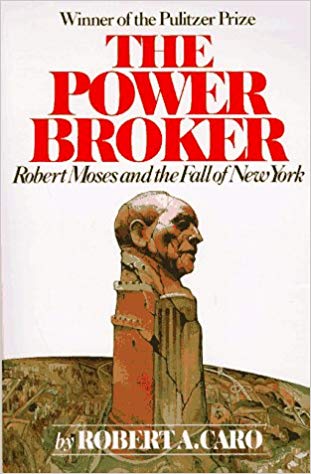
Robert Caro (the author) believes that mass transit is the solution to all of New York’s transit problems. Bob Moses believes that investing in car pathways highways is the solution. There’s no clear answer for the time frame in question since the care was just starting to become mainstream when Moses was pushing for highways to cross over Manhattan but Caro has very strong inclination. So the biography of Bob Moses is fantastic detailed, amazing but of course there will be biases.