Renegades weren’t such a problem to Steve Jobs. In fact, he respected those who stood up to him if they knew what they were talking about on the Macintosh team. Often if they disagreed with Jobs, they realized that they could ignore Jobs’ commandments, and in so doing effectively spare Jobs the embarrassment of making a mistake or a bad judgement. One such incident involved the disk drive called Twiggy which was defective in the Lisa. The alternative would be a 3½ disk drive which was designed by Sony. The dirty Tokyo disk drive factory in Sony did not impress Jobs and he wanted to go with Alps disk drive which had made a clone of the Sony product. So Jobs decided to do a deal with Alps (a competing manufacturer), but Bob Belleville (behind Jobs’ back) decided to hire Sony in secret without Jobs’s approval.
Belleville hired Komoto who was tasked with building a disk drive for the MacIntosh from 1982-83, but Belleville did not want Jobs to know about this backup plan for the disk drive collaboration taking place at Alps, the Japanese company. Whenever Jobs came through the Macintosh office, Komoto was quickly escorted into a closet, or under a desk where he would have to hide for a few minutes at a time. In May 1983, the Alps team in Japan failed to deliver their disk drive, and asked for an additional 18 more months to work out the problems. It was a disaster as Mark Markkula grilled Jobs about what he was going to do about the lack of a disk drive with the MacIntosh launch potentially being pushed back to 1985? Bob Belleville saved Jobs by interjecting that Bob had a disk drive ready thanks to his secret work without Jobs’ approval. Jobs appreciated this renegade behaviour, and swallowed his pride. So we can infer that winning is more important than being right in management.
This is an analysis based on Steve Jobs by Walter Isaacson and other sources of research. Enjoy.
A Clean Factory Is Insanely Great But The Product Has To Sell:
Freemont, California was the location of Apples new automated factory overlooking the Ford manufacturing facility. Apple was more profitable in its early years of existence relative to Ford. Apple was indeed a miraculous company. Jobs spent time going over the machines in the new factory in 1984, at one point, he demanded that the Apple team repaint the machines for aesthetics. This repainting actually screwed up their machines, however, and corrections proved costly. The Apple factory had white walls, and beautiful machines. Jobs believed the factory was a way to establish a passion for Apple amongst employees. Jobs was influenced by the Japanese manufacturing which had a sense of team and discipline. Debby Coleman, a Stanford MBA, was the operations manager. By the end of 1984, the Macintosh’s performance in sales was very low. They had an expensive factory but a failed product.
This is an analysis based on Steve Jobs by Walter Isaacson and other sources of research. Enjoy.
When Scully joined Apple, he was surprised at the disorder, and bickering between Jobs and the Lisa team over a) why Lisa was a failure, and b) why Macintosh had not been launched in 1983. Scully felt that Apple was ‘like a household where everyone were running to the beach when there was an earthquake only to discover a tsunami was approaching that forced them back into the house.’ (Isaacson Biography). Things weren’t great on the numbers side for Scully’s first year as CEO either. He had to announce at the 1984 shareholders meeting that 1983 was a bad year for Apple. It was. The competitors were entering the market with cheaper products that were not as user-friendly as Apple but still semi-useful machines. The Apple balance sheet still showed major growth but IBM had launched the PC, and there were many lower-priced clones on the market in 1981 onward which were harming Apple’s competitive advantage.
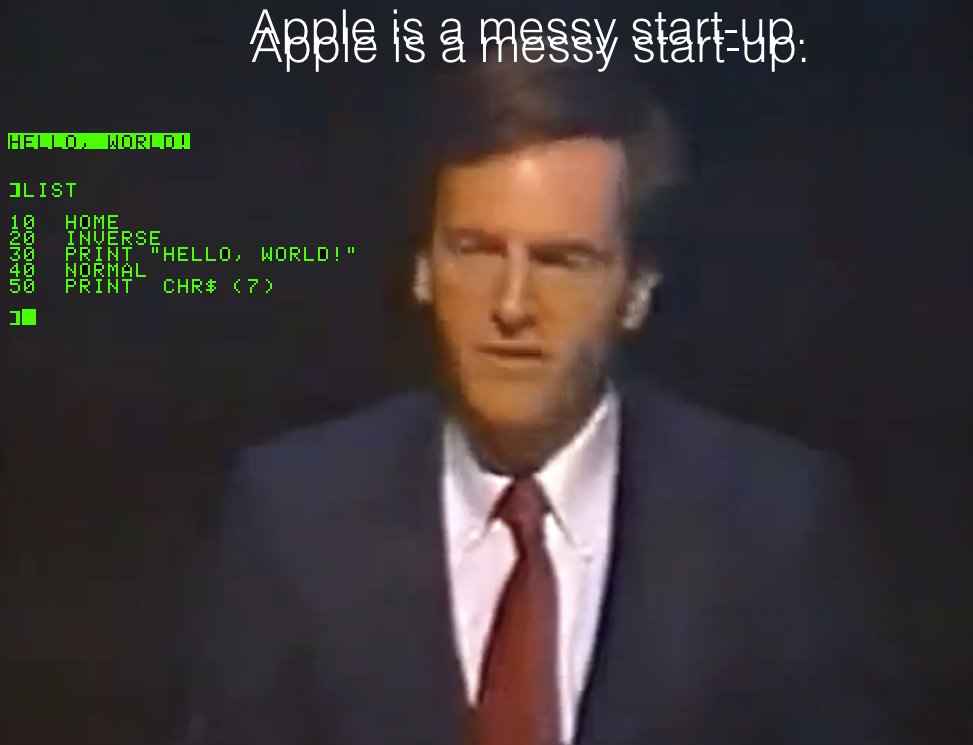
But Macintosh was marketed as “the computer for the rest of us” and would refocus Apples efforts away from their core Apple II & LISA product offerings. Apples future was bright because there were 25 million information based users in offices across America, and their work had not changed much since the industrial revolution. The only desktop product people used was the phone until the personal computer. Apple hoped that their market share would expand with the unveiling of Macintosh….1984 would prove pivotal for Apples future (to be continued). Below is the balance sheet for the January 24th, 1984 Apple Shareholders meeting. Apple was a chaotic start-up turned revolutionary full fledged company. It was a messy operation from the standpoint of senior management but generally Apple worked.
The Apple Computer, Inc Balance Sheet In 1983
Current Assets
Fiscal Year 1983
Cash and Investments
$143,000,000
Receivables – Net
$136,000,000
Inventory
$143,000,000
Other
$47,000,000
Total Current Assets
$469,000,000
Net Fixed Assets
$67,000,000
Other Assets
$21,000,000
Total Assets
$557,000,000
Current Liabilities
$129,000,000
Long-Term Liabilities
$50,000,000
Shareholders’ Equity
$378,000,000
Total Liabilities & Equity
$557,000,000
This is an analysis based on Steve Jobs by Walter Isaacson and other sources of research. Enjoy.
The 1984 Ridley Scott advertisement entitled “1984” was a way of affirming a desired renegade style, and attached Apple Computers with the rebels, and hackers. Ironically, Apple was a controlled system. Jobs believed in total control. Initially, the 1984 Ad was not popular on the board at Apple. Markkula and Scully thought it was the worst commercial ever, and that they should not put it on during the Superbowl. They were proven wrong by the timelessness of that 1984 Ad. The next advertisement in 1985 was an ad focused on insulting business people by showing them that they were walking off a cliff as if to suggest that they were blindly following the IBM brand. When the commercial was featured at the 1985 Superbowl in January, there was little reaction, and in truth it was a blunder since it insulted the market it was trying to reach. Apple performed poorly in 1985, the ad is not the cause of the outcome but was a symptom of Apple’s situation in 1985; IBM was expanding immensely.
Frame Your Business Around War – Big Blue Versus Apple:
During the 1984 Apple shareholder meeting, Jobs set the stage for the epic conflict between IBM and Apple. The question Jobs asked at the 1984 conference was “Will Big Blue dominate the entire computer market? Will they control the entire information age? Was Geroge Orwell right?” These rhetorical questions helped inspire his company. Afterall, IBM did not have the vision to buy Xerox in the 1950s. Computer dealers fear IBM dominance on pricing. For Jobs, it was about Apple versus evil. Apple is the only hope against Big Blue. With that frame of mind, Apple could do anything. The MacIntosh was finally launched on “time” in January, 1984.
This is an analysis based on Steve Jobs by Walter Isaacson and other sources of research. Enjoy.
 Being Right Isn’t As Important As Winning
 This is an analysis based on Steve Jobs by Walter Isaacson and other sources of research. Enjoy.